
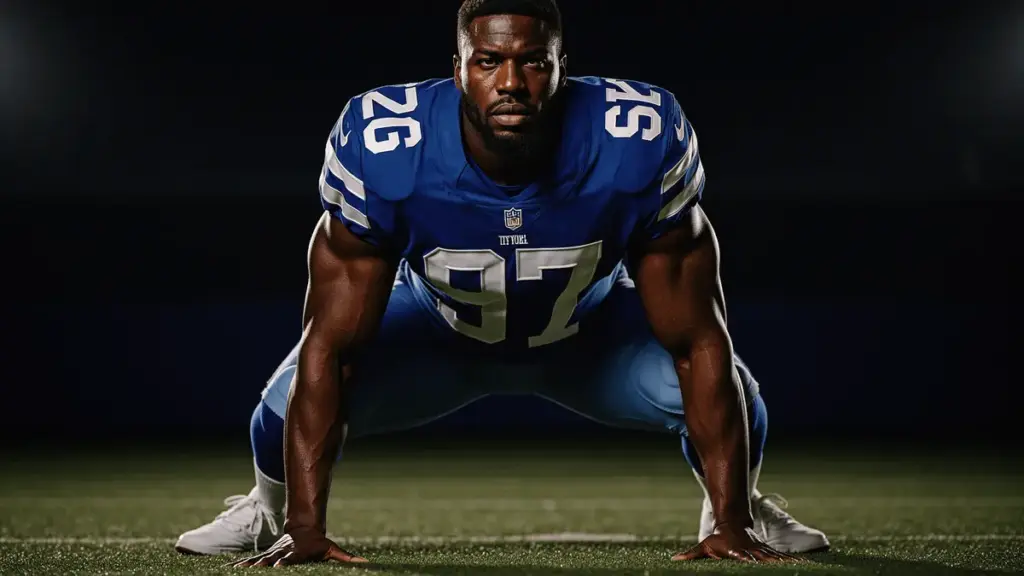
The New York Giants traded Dexter Lawrence to the Cincinnati Bengals for the No. 10 overall pick in the 2026 draft, and Joe Schoen now owns every consequence of that decision, with the roster rebuild, Jaxson Dart’s development, and the Giants’ defensive identity all riding on whether a distributed pressure model can replace one genuinely elite interior force.
Lawrence’s Value Was Real – The Giants Traded It Anyway
Dexter Lawrence was not a rotation piece who wore out his welcome. He posted 7.5 sacks in 2022 and earned second-team All-Pro honors in back-to-back seasons, becoming the most reliable defensive player the Giants had developed in years.
The Bengals valued him enough to send a top-10 pick and immediately extend him through 2028 at $28 million for one additional year, which tells the entire market everything it needs to know about his standing.
Both things can be true simultaneously: Lawrence’s 2025 production dipped to 0.5 sacks and his PFF run-defense grade fell to a career-worst 57.0, and Cincinnati still treated him like a premium, win-now centerpiece worth paying.
The Giants can sell the cap math – his 2026 hit sat near $26.96 million with no remaining guarantees – but the football argument for moving him was never as clean as the financial one.
New York still generated 34 pressures from Lawrence last season even in a down year, and interior pass-rush production at that volume does not just materialize from committee-based replacements.
The Giants made the bold call. The burden of proof now belongs entirely to them.
The Honest Qualifier: Replacing a Star With a System Is Not the Same Thing
The honest qualifier sits right next to the cap logic, and it is uncomfortable.
D.J. Reader, Brian Burns, Abdul Carter, Kayvon Thibodeaux, and a deeper linebacker group behind them is a reasonable construction on paper, but reasonable constructions do not automatically produce the pocket disruption one dominant interior tackle generates.
The Giants are asking five moving parts to do what one identity player did consistently.
Roy Robertson-Harris tore his Achilles before this rotation even took a regular-season snap together, which immediately exposed how thin the margin is behind Reader.
Josh Tupou provides size, but nobody should confuse rotation depth with star-caliber replacement. The injury already happened before the first preseason week, and the Giants have no safety valve if Reader does not provide the early-down control the scheme requires from him.
The distributed-pressure formula only works when every component performs at or near its ceiling simultaneously, which is a far less stable foundation than anchoring around one proven force.
If Thibodeaux does not bounce back and Carter takes normal rookie adjustment time, the entire structure compresses under pressure, and Schoen absorbs all of it.
What the Lawrence Trade Means for the Giants’ Defensive Construction
The pick the Giants received at No. 10 became Francis Mauigoa, and how quickly he develops into a legitimate interior presence is now inseparable from how this trade gets judged.
If Mauigoa becomes the next long-term anchor on this defensive front, the decision looks structurally sound in retrospect.
If he needs two or three years to reach that level, the Giants will spend that entire period trying to stop teams without their best defensive lineman.
As this site’s coverage of the Giants’ roster development strategy and investment in young talent documents, New York is building around a long-term framework, not a win-now mandate.
That context makes the Lawrence trade easier to rationalize philosophically, but the defensive front still has to function in 2026 while the rebuild matures around Dart.
Schoen’s contract extension connects him directly to this outcome.
The Lawrence trade was not a footnote decision – it was a franchise-reshaping call, and the Giants’ ability to stop opposing offenses this season will either validate or indict that judgment before the calendar reaches December.
Fantasy and Betting Implications of the Giants’ Defensive Overhaul
Bettors pricing the Giants’ season win total need to account for how much interior run defense degrades without Lawrence anchoring the middle.
Opponents will test Reader and Tupou on early downs immediately, and if that run-stop grade slips below league average, the secondary gets exposed on play-action at a much higher rate.
The Giants’ defensive unit props – sacks, turnovers, points allowed – carry real downside risk in a transitional defensive construction.
Fantasy managers who roster opponents facing the Giants early in the 2026 schedule have a window to exploit this front before the rotation finds cohesion.
Burns and Carter are legitimate pass-rush assets in defensive fantasy formats, but their value is ceiling-dependent on Reader holding up as the base-down anchor who keeps them in favorable rushing situations.
Target both players in DFS, but do not overpay expecting last year’s Lawrence-era pressure rates to immediately transfer.
The Next Hard Checkpoint Is the First Eight Weeks of the 2026 Season
The diagnostic window that settles this debate is Games 1 through 8 of the 2026 regular season, specifically the Giants’ run-defense grade, interior pressure rate, and points allowed per game against opponents who attack the middle of the line.
If Reader provides genuine early-down control and Carter generates consistent interior push alongside Burns, the distributed model earns its credibility. If the defensive interior leaks through October, the offseason rationale stops mattering to anyone.
Schoen bet the team’s defensive identity on this construction, and nobody in the building gets to call it a success until the field results arrive. NY Sports Day will have full Giants coverage as it develops.
About the Author
