
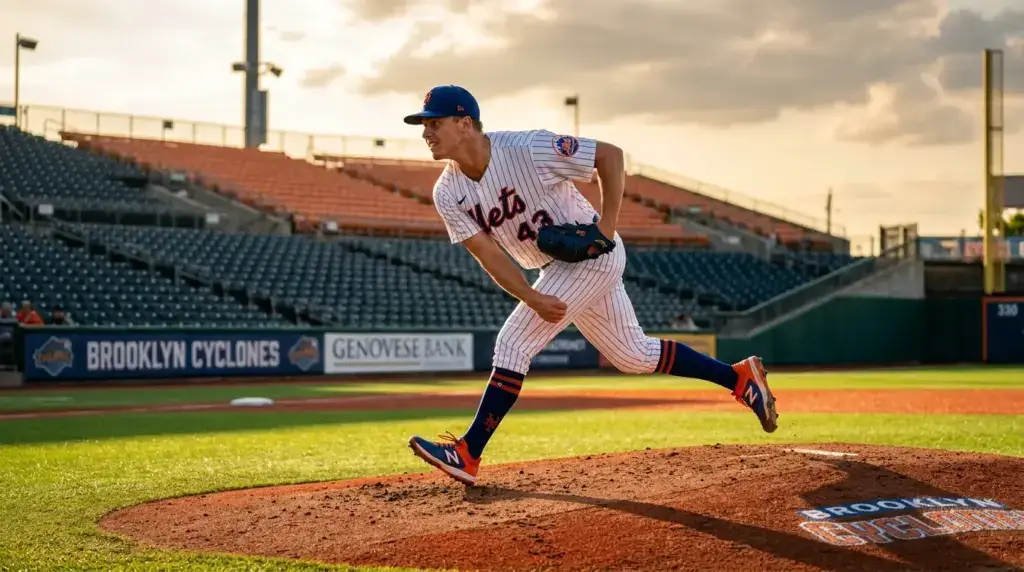
Kodai Senga will make his first minor league rehab start Friday for Class A St. Lucie, per ESPN, officially beginning the competitive ramp-up that Mets fans have been waiting on since he was shut down with lumbar spine inflammation in late April.
This rotation needs him – it has needed him for weeks – and the staff around him has been patchwork at best while he’s been sidelined.
The honest caveat lands immediately: a rehab assignment is a starting gun, not a finish line, and a 33-year-old pitcher who posted a 9.00 ERA before his back gave out has more to prove than just durability.
The next few weeks will tell you everything about whether Senga is actually back or just back on a mound.
The Medical Picture Is Moving in the Right Direction – But Rehab Assignments Have a Way of Revealing Things
Senga has been on the injured list since late April with what the Mets have classified as lower back pain and lumbar spine inflammation – the kind of diagnosis that sounds manageable until it isn’t.
He has not thrown a competitive pitch since April 26, a gap of well over a month by the time Friday’s St. Lucie start arrives.
The most recent checkpoint before this one was a live batting practice session of roughly 40 pitches, which went cleanly enough that manager Carlos Mendoza greenlit the rehab assignment without hesitation.
Mendoza was direct about it Thursday before the Mets’ series finale against Washington:
“He feels really good and he’s ready to go in competition, so he’s pitching tomorrow.”
– Carlos Mendoza, Mets manager
That optimism is noted. It’s also exactly what a manager says when a live BP goes well and the player is eager. The actual evaluation happens over innings, not in a pregame media session.
Friday’s start carries a 50-60 pitch limit and a four-inning maximum – both standard guardrails for a first competitive outing after a back issue of this kind.
Once Senga begins a rehab assignment, the clock starts: he has up to 30 days to demonstrate he’s ready for activation.
The next real checkpoint is how his back responds in the 24-48 hours after Friday’s outing.
That’s the number that matters, not the pitch count or the strikeout total.
What New York Actually Gets Back – And What the Rotation Has Looked Like Without Him
Senga’s career line with the Mets is 20-17, 3.39 ERA across 57 starts – every single one of them in a New York uniform.
That résumé is built on elite swing-and-miss stuff, particularly a ghost fork that generates some of the ugliest whiffs in the sport when it’s working.
The problem is that it hasn’t been working this season. His 0-4 record and 9.00 ERA across five starts before the IL stint was not a small-sample fluke – it was a legitimate red flag about whether he had rediscovered his mechanics after missing essentially all of 2024.
As our Mets stock watch breakdown noted, the rotation’s depth concerns didn’t start with Senga’s IL stint – they predate it, and his early-season struggles were already part of the conversation before the back flared.
A healthy, 2023-version Senga at the back or middle of this rotation changes the calculus entirely.
A Senga still searching for his stuff, just physically available, changes very little.
The Mets will also get back some bullpen reinforcement around the same time. Left-hander A.J. Minter, returning from left lat surgery, appeared in back-to-back rehab games this week for the first time this year and is slated to pitch for Triple-A Syracuse again Saturday.
Mendoza’s framing – “then we’ll probably have a discussion” – suggests Minter is close. First baseman Jared Young, rehabbing a left meniscus tear, is 2 for 14 in four rehab games and still working on his timing.
Multiple roster moves are converging at once, which is either a sign that the team is getting healthy or a logistical puzzle the front office hasn’t fully solved yet.
The Timeline Is Moving – Here’s What to Watch Before He’s Back in Queens
If Friday’s start goes clean – meaning his back holds, the stuff shows at least flashes of its previous form, and the recovery is uneventful – the Mets can map out a second and possibly third rehab start to build his pitch count toward a starter’s workload.
A typical ramp from 55 pitches to a game-ready 85-95 takes two to three outings minimum, which puts his earliest realistic activation somewhere in mid-to-late June. That timeline is tight but not impossible.
The variable that matters most isn’t velocity or strikeouts on Friday. It’s how the lumbar spine responds to the competitive effort – the adrenaline, the drive mechanics, the full-intensity delivery.
Back inflammation in pitchers has a way of announcing itself most clearly after the adrenaline wears off.
As we covered when Clay Holmes was navigating his own injury and return timeline earlier this month, the post-outing window is where rehab assignments either build confidence or immediately reset expectations.
Senga’s Saturday morning will tell you more than his Friday evening.
The Bigger Picture: What a Healthy Senga Does to the Mets’ Season Math
The Mets need a real answer at the top of their rotation, and they need it before the trade deadline makes the question irrelevant.
A Senga who returns and looks like the pitcher who made the 2023 All-Star Game is a genuine difference-maker – someone who can eat innings, miss bats, and give this offense a chance to win games without needing to score six runs.
A Senga who returns and continues to look like the early-2026 version is a sunk cost that the front office will have to work around while the deadline approaches.
If the rehab assignment goes well and he’s activated by mid-June, the Mets have a real argument for keeping their options open at the deadline rather than overpaying for rotation help.
If the back flares again or the results stay ugly, that changes the front office’s entire posture – and the price of every available starter on the market goes up accordingly.
St. Lucie is the starting point, not the destination. Watch Friday, then watch Saturday morning. That’s where this story actually begins.
About the Author
