
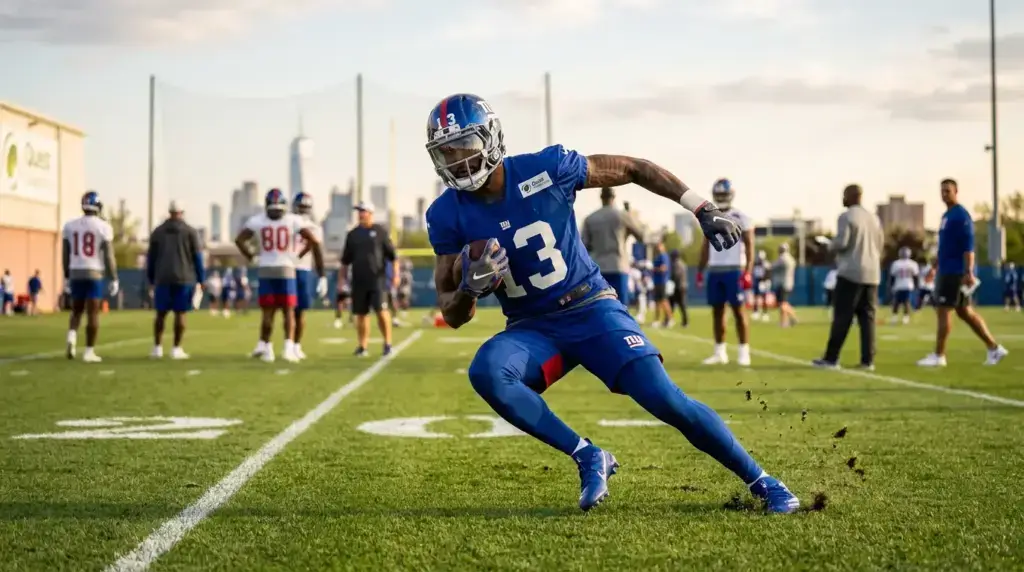
Malik Nabers was on the field, moving freely, aligned outside and in the slot, running motion looks and stacked-formation concepts with the first-team offense.
That is the single most important thing that happened at Giants OTA practice No. 3 on Thursday in East Rutherford.
Everything else – the defensive fronts, the quarterback reps, the running back rotation – matters.
But Nabers being out there and being featured, not managed, is the data point that frames all of it.
His return timeline has been a genuine source of anxiety this offseason, and Thursday was the first real evidence that the best-case scenario is still in play.
Nabers’ Usage Pattern Already Signals Intent – Not Just Availability
The Giants aren’t easing Nabers into OTAs like a receiver coming off a significant procedure. They’re using him.
Outside alignments, slot alignments, motion concepts, stacked formations – this is a staff immediately telling you that Nabers is a volume target across multiple deployment looks, not a perimeter deep threat they’ll protect with limited route trees.
That has direct implications for what Matt Nagy’s offense is actually built around.
The alignment diversity matches what Baltimore’s most complex receiving concepts looked like – receivers who can play multiple spots force defenses to account for them on every snap, not just in obvious formations.
With Nabers healthy and running those concepts in May, the Giants are building the timing and trust that only comes from repetition.
The optimism is real. The next confirmation is mandatory minicamp June 8–10, where practice intensity increases and the installation gets more situational.
If Nabers is still in that same role with the same usage rate by then, this stops being an early sign and starts being a projection.
Jaxson Dart’s Rep Split Is Not Standard Rookie Treatment
Jaxson Dart worked primarily with the second unit in Thursday’s open session – that part is expected.
What isn’t standard is that he also mixed into scripted first-team reps in red-zone periods, while presumed starter Drew Lock handled the bulk of first-team snaps overall.
SNY’s coverage and Giants-focused YouTube breakdowns flagged this split as deliberate fast-tracking, not organizational charity.
Mid-round rookies do not get situational first-team reps in OTA week three unless the staff is actively evaluating their ceiling on an accelerated schedule.
Harbaugh ran a similarly structured evaluation process in Baltimore when he had young quarterbacks he needed to assess quickly – the reps were earned, not gifted, but they came earlier than convention suggested.
None of this means Dart starts Week 1. It means the Giants are not treating him like a clipboard holder.
That distinction matters. Harbaugh’s program has demanded immediate accountability from every player in the building, and Dart is apparently not exempt from that standard – or from its opportunities.
Macdonald’s Defense Is Already Showing Baltimore DNA
Mike Macdonald showed multiple fronts on Thursday, including stand-up and hand-in-the-dirt alignments for Kayvon Thibodeaux, plus simulated pressure concepts with both inside linebackers mugging the A-gaps pre-snap before dropping into coverage.
That is a direct import from what Macdonald built in Baltimore and then refined in Seattle – defenses that make offenses declare their blocking assignments before the snap and then punish them for guessing wrong.
Thibodeaux’s wider alignment is worth noting specifically. Under Wink Martindale, Thibodeaux was often asked to work inside stunts and compressed alignments.
What Thursday showed looks more like true one-on-one pass-rush positioning – the kind of usage that maximizes an elite athlete’s ability to win with speed and leverage rather than scheme.
If that alignment holds, Thibodeaux’s 2026 production ceiling just got recalibrated upward.
In the secondary, second-year DBs and new additions rotated heavily through three-safety packages, with Beau Brade and Ar’Dell Reese used interchangeably deep and in the box.
Macdonald’s Baltimore defenses were built on exactly this kind of positional interchangeability – making it structurally difficult for offenses to identify pre-snap looks. One OTA session doesn’t confirm the system is installed.
It confirms the vocabulary is being taught.
What Mandatory Minicamp Actually Has to Answer
The most unresolved tension coming out of practice No. 3 isn’t Nabers’ health – it’s whether Dart’s workload with the starters expands or contracts as the install gets more complex.
OTA scripting is controlled. Minicamp is where the defense adjusts and the quarterback has to process, not just execute.
If Dart holds his own in those periods – specifically in red zone and two-minute concepts – the Giants have a real quarterback competition brewing underneath the surface.
If Lock reasserts clean separation in those high-leverage windows, the evaluation phase ends and the depth chart settles. June 8 is when that question gets pressure-tested.
Nabers on the field, Thibodeaux repositioned, Dart being evaluated ahead of schedule.
Three practices in, and Harbaugh’s Giants already have more signal than most teams generate in a full spring.
The mandatory minicamp either confirms the pattern or complicates it. Either way, it’s worth watching closely.
About the Author
