
Locking in Breece Hall for two more years was the right move – and it immediately created a different kind of problem.
The Jets now have a running back room with a clear workhorse at the top and two legitimate young pieces behind him who are too good to sit and too expensive to carry as pure insurance.
That is not a depth chart – that is a roster inefficiency with a deadline on it.
Both Isaiah Davis and Braelon Allen have two years remaining on their rookie deals, which means their value is real and their window is closing.
New GM Adam Peters’ track record in San Francisco and Washington points clearly toward one conclusion: when you have surplus at a position, you flip it for capital.
The Jets are quietly in the business of doing exactly that this offseason, and the broader approach to roster construction this spring has already reflected that kind of intentionality. Three trade routes are worth watching closely.
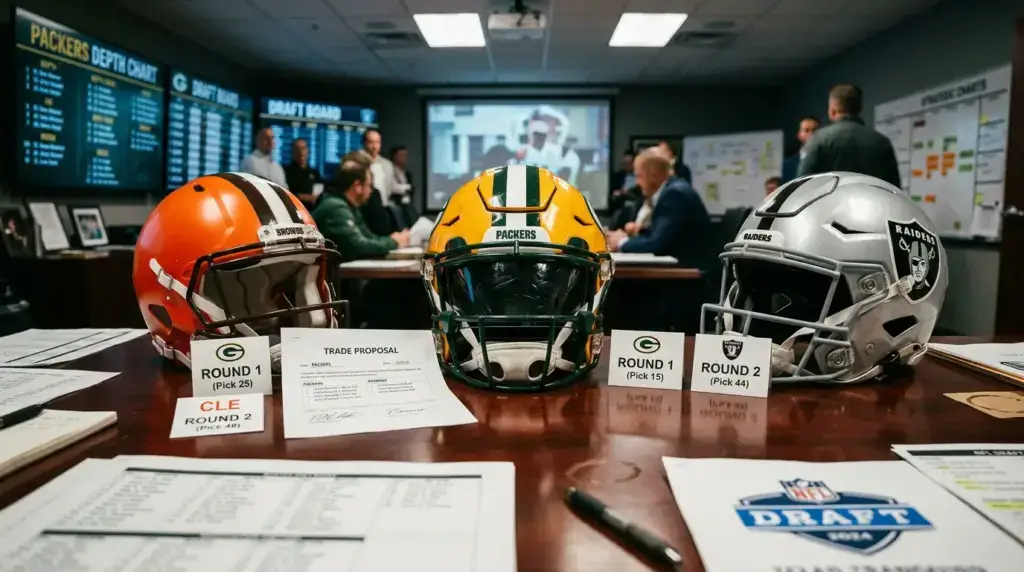
Green Bay Wants a Backfield Answer – Allen Gives Them One
The Green Bay Packers are the most obvious landing spot, and obvious here does not mean wrong. Josh Jacobs is still their starter, but his injury history is real and his 2025 campaign was a step back from his All-Pro peak.
His contract carries a potential out after 2026 with minimal dead cap in 2027, which means Green Bay is already at least half-looking at what comes next.
What comes next behind Jacobs right now is essentially nothing. MarShawn Lloyd, the third-round pick from the same draft class as Allen and Davis, has logged 15 rushing yards in two NFL seasons.
Emanuel Wilson and 2025 UDFA Nate Noel have combined for fewer than 70 career offensive snaps.
That is not a rotation – that is a liability waiting to be exploited on any week Jacobs misses.
Braelon Allen is the name that fits here most cleanly. The homecoming angle is real – Allen is a former Wisconsin Badger – but GM Brian Gutekunst is not paying for sentiment.
He is paying for a young, proven RB2 who can push Lloyd, spell Jacobs when needed, and give the offense a reliable ground option at a moment when Green Bay just lost both Romeo Doubs and Jayden Reed from its receiving corps.
Leaning on the run game matters more now, not less.
Allen’s 54.3 percent success rate on third-and-short situations in 2025 ranked top-10 among qualifying backs. That is a specific skill Gutekunst can use immediately.
The Jets and Browns Have Done This Before – Judkins’ Injury Makes It Timely Again
The front offices know each other. Elijah Moore went from New York to Cleveland in 2023. Jowon Briggs went the other direction in 2025. Demario Davis made the same trip in 2017.
The relationship exists, the trust exists, and now the need exists on Cleveland’s end.
Quinshon Judkins is the Cleveland Browns‘ best offensive weapon – and he dislocated his ankle and fractured his fibula in Week 16.
The recovery window is four to six months, which puts his training camp availability in genuine question. Even if Judkins returns clean, what is behind him offers almost no margin for error.
Dylan Sampson, a 2025 fourth-round pick, managed 175 yards on 65 carries as a rookie.
Undrafted options Raheim Sanders and Ahmani Marshall round out a depth chart that would be problematic even without Judkins’ injury in the picture.
Cleveland finished bottom-five in offensive DVOA in 2025 and ran the ball out of necessity more than design.
A team that desperate for ground-game production cannot go into the season with Sampson as its primary contingency.
Davis, who averaged 3.2 yards after contact per rush last season, would be an immediate functional upgrade and a genuine complement to Sampson’s receiving ability out of the backfield. The Browns have every reason to make this call.
Las Vegas Has Jeanty – and Almost Nothing Else
The Las Vegas Raiders situation is the starkest of the three. Ashton Jeanty, the No. 6 overall pick in 2025, is the unquestioned workhorse.
His rookie season left something to be desired, but the investment is made and the commitment is real. What surrounds him is not a depth chart – it is a collection of question marks.
Dylan Laube, a 2024 fourth-rounder, saw seven carries last season. Chris Collier has 12 career NFL rushing yards.
New rookie Dylan Washington, taken in the fourth round in April, has intriguing qualities and zero NFL track record.
New OC Luke Getsy’s outside-zone scheme favors downhill, one-cut runners who can handle volume in a pinch – none of the current Raiders backups behind Jeanty fit that profile with any confidence.
Davis or Allen would be immediate upgrades at the RB2 spot and more reliable than Washington as the RB3 right now.
With two years left on their deals, either player fits perfectly into a Las Vegas rebuild that is still early enough to need proven pieces at every layer.
That is not a cheap ask in terms of draft capital – but the Raiders have the motivation to have the conversation, and the Jets have the leverage of offering two options instead of one.
What to Watch as Camp Approaches
The most important signal to track is whether the Jets carry both Allen and Davis into training camp.
If one disappears from depth chart projections or sees a sharp drop in reported reps, a deal is likely close.
Roster cutdown season is when these conversations crystallize – teams get a clearer picture of their own needs, and the Jets get a better sense of what the market will bear for either player.
Watch the Judkins injury timeline specifically. If he is still limited heading into late July, Cleveland’s urgency increases significantly, and that is when the price for a Jets back goes up, not down.
The draft capital New York accumulated this spring already signals a front office that understands asset management. Trading a surplus back for a mid-round pick is exactly the kind of move Peters’ philosophy is built around.
The Jets have had plenty of offseasons where depth was shuffled without intention.
This one is different – and the running back room is the next place that principle gets applied.
About the Author
