
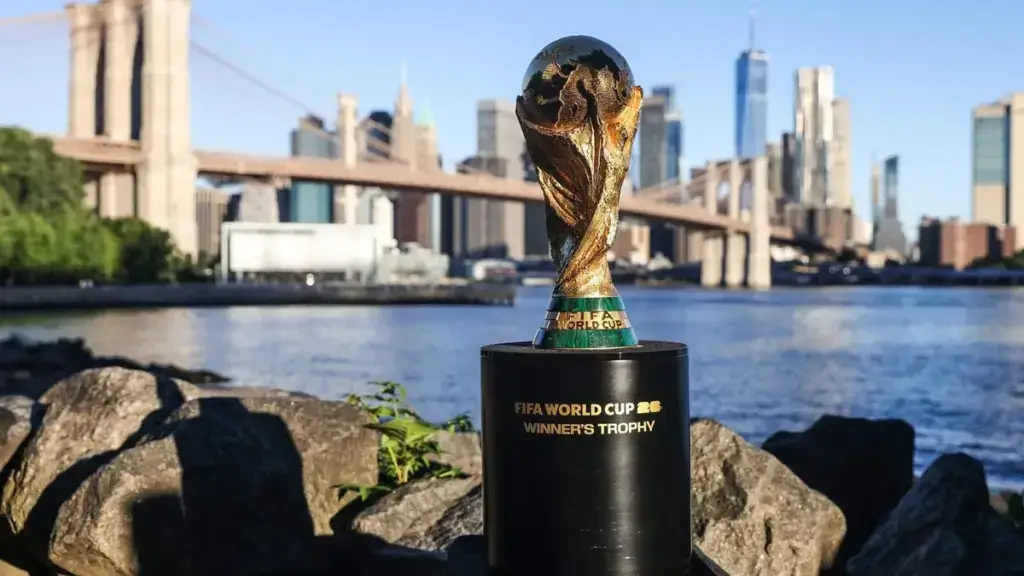
The 2026 FIFA World Cup hasn’t kicked off yet, but a full-blown political battle is already underway — and it’s being fought on the rail lines between Penn Station and MetLife Stadium.
New Jersey Governor Mikie Sherrill and FIFA have publicly traded blows over who should foot the bill for NJ Transit tickets to World Cup matches at MetLife Stadium, which have now been confirmed at $150 for a round-trip — nearly 12 times the regular $12.90 fare for the roughly 15-minute, 9-mile ride from Manhattan’s Penn Station to the stadium.
With MetLife Stadium set to host eight matches this summer — including the July 19 final — the transportation chaos surrounding one of the world’s biggest sporting events has turned into one of its most heated political controversies.
What Did Governor Sherrill Say About FIFA and World Cup Transportation Costs?
Sherrill didn’t mince words. The New Jersey governor posted on X that her administration “inherited an agreement where FIFA is providing $0 for transportation to the World Cup,” while NJ Transit is stuck with a $48 million bill to safely move fans to and from games — all while FIFA is set to make $11 billion.
She made clear she wasn’t going to let Garden State commuters absorb the hit.
Sherrill vowed that if FIFA did not chip in to cover the estimated $48 million in costs New Jersey is bearing to host World Cup games, she would pass the costs along to fans — adding that she would not make everyday commuters foot the extra expense.
Sherrill went further in a radio interview on WNYC, saying: “We’ve already reached out to FIFA saying, ‘Look, this is going to cost about $50 million to move people. The best possible outcome would really be for FIFA to take on this cost.'”
How Did FIFA Respond to Governor Sherrill’s Demands?
FIFA came out swinging in its own right. A FIFA spokesperson issued a pointed statement saying the organization was “quite surprised by the NJ governor’s approach on fan transportation,” before pointing to the original FIFA World Cup 2026 Host City Agreements.
FIFA noted that the Host City Agreements signed back in 2018 required free transportation for fans to all matches, and that the requirements were modified in 2023 to instead secure access to transit — public or otherwise — to match venues.
FIFA also pushed back on the $11 billion figure Sherrill cited.
The organization clarified that while it is projected to generate approximately $11 billion in revenue, that is not profit, and that FIFA has always operated as a not-for-profit organization — with revenues reinvested into developing the game of football worldwide, particularly for youth and women.
Why Are NJ Transit World Cup Fares So High?
NJ Transit President and CEO Kris Kolluri defended the $150 round-trip price, saying the cost was necessary to recoup the $48 million expense of running dedicated trains to MetLife Stadium.
He was direct about the math: “This isn’t price gouging. We’re literally trying to recoup our costs.”
On match days, NJ Transit and the FIFA New York New Jersey Host Committee warned that “travel will look different from a typical day,” urging those not attending games to avoid nonessential travel.
Making matters worse for fans, parking has been banned at MetLife Stadium despite thousands of spots being available in the Meadowlands Sports Complex, because those lots will be used for fan activation and security.
For drivers looking to get as close as possible, parking passes at a nearby mall are selling for $225.
FIFA’s Chief Operating Officer Warns of “Chilling Effect”
FIFA isn’t just angry — it’s worried about the broader consequences.
Heimo Schirgi, FIFA’s chief operating officer for the 2026 World Cup, criticized the price hikes as having a “chilling effect,” warning that elevated fares inevitably push fans toward alternative transportation, increasing congestion, late arrivals, and diminishing the economic benefit and lasting legacy the entire region stands to gain from hosting.
FIFA also pointed out the stark contrast with other host cities.
According to the organization, round-trip mass transit tickets to venues in Houston and Atlanta will cost $2.50, and $3.50 in Los Angeles.
Is New Jersey the Only World Cup Host City Facing a Transit Crisis?
New Jersey is the most extreme case, but it isn’t alone.
In Boston, a round-trip bus ticket to Gillette Stadium will cost $95, while the MBTA’s special express train service — which already prompted public outcry — charges $80 for the roughly 30-mile trip to Foxborough and back, several times the typical fare.
In contrast, Philadelphia’s transit agency SEPTA said there would be no fare increase for World Cup games, with most added operating costs covered by a recently awarded federal grant. Atlanta is also offering affordable public transportation to matches.
What Happens Next for World Cup Fans Traveling to MetLife Stadium?
For now, fans heading to MetLife Stadium this summer need to budget accordingly.
Penn Station will have severe restrictions on game days, when only match attendees will be permitted to enter the NJ Transit portion of the station.
A valid FIFA World Cup 2026 match ticket will be required to purchase transportation and access matchday services.
The war of words between Sherrill and FIFA shows no sign of cooling — and with the first MetLife Stadium match scheduled for June 13, time is running short for a resolution that works for fans, commuters, and both sides of this very public fight.
About the Author
