
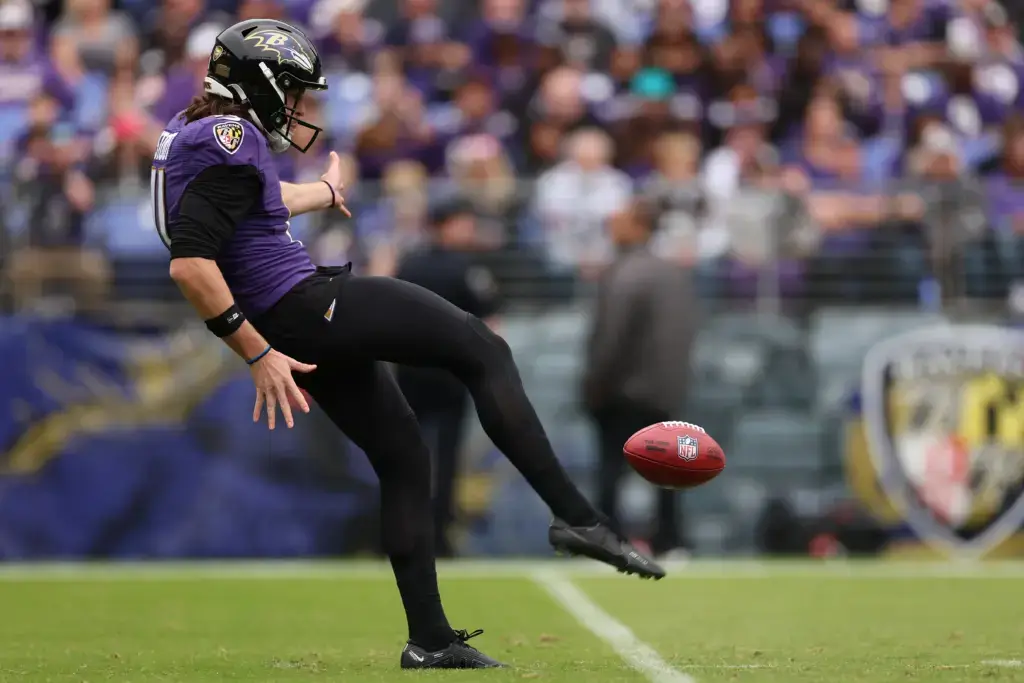
The New York Giants reset the punter market this week when they signed Jordan Stout to a three year contract worth $12.3 million. It is an unusual headline for free agency, but the move reflects a deliberate philosophy shift under head coach John Harbaugh.
Harbaugh has always treated special teams as a core part of roster construction, and the Giants appear ready to follow the same blueprint. Stout arrives from Baltimore after a breakout 2025 season that earned him First Team All Pro honors. The real debate is whether the numbers behind his performance justify making him the highest paid punter in football.
Jordan Stout Contract Details After Giants Make Him Highest Paid Punter
New York’s deal with Jordan Stout averages just over $4 million per year. That figure leads the NFL for punters, though it still represents a small slice of the salary cap compared with most positions.
Stout arrives with momentum after a standout season in Baltimore. In 2025 he punted 53 times for 2,657 yards, producing a 50.1 yard gross average and a 44.9 yard net average. Those numbers placed him among the league’s leaders and gave the Ravens one of the most consistent field position weapons in the league.
The Giants are paying for that consistency rather than one highlight kick.
Jordan Stout Stats Show Why Giants Targeted The Ravens Punter
The raw punting numbers help explain why Stout became such a priority. His 50.1 yard gross average ranked among the best marks in the league last season, while his 44.9 yard net average ranked first among qualifying punters.
League averages tend to sit several yards lower, particularly on net punting where coverage and hang time play a role. That gap can quietly accumulate across a full season.
Analytics models that track punter efficiency try to measure this through expected points added. Using the Puntalytics model, Stout produced roughly 0.10 expected points added per punt in 2025 across 53 kicks. Over the full season that translates to a little more than five expected points above an average punter.
Converted into wins, that impact sits somewhere in the range of a fraction of a victory across a season. It is not a massive swing, but it represents measurable value when a team is trying to gain incremental edges.
Giants Special Teams Strategy Under John Harbaugh
The signing also reflects the philosophy of the new coaching staff. Harbaugh spent more than a decade in Baltimore emphasizing special teams discipline, directional punting, and field position control.
Stout already operated inside that system. Bringing him to New York gives the staff a punter they trust to execute the same approach immediately.
Harbaugh has not stopped with one former Raven either. The Giants have also signed Baltimore tight end Isaiah Likely, another player who is following his former coach to New York.
The pattern suggests Harbaugh is trying to import pieces of the culture he built in Baltimore.
Jamie Gillan Comparison Shows Why Giants Upgraded At Punter
New York previously relied on Jamie Gillan, who averaged roughly 45 yards per punt across his career. Gillan has delivered solid moments, but the statistical gap between him and Stout appears in both gross and net punting numbers.
A difference of two to four yards per punt may sound small. Over roughly 50 punts in a season, that difference can move opposing offenses dozens of yards in total field position.
Analytics models attempt to capture that effect. The expected points numbers show Stout producing measurable positive value compared with average punters, which is exactly the margin the Giants appear to be targeting.
Is Paying A Punter Worth It For The Giants
The contract ultimately comes down to probability. If Stout continues to perform at an All Pro level, the Giants will likely gain several expected points over the course of a season compared with an average punter.
Those edges rarely dominate headlines, but they do influence starting field position and defensive game plans across dozens of drives.
If his production slips closer to league average, then the contract simply becomes an expensive way to gain a marginal upgrade.
What the move clearly signals is how the Giants intend to play. Harbaugh’s teams have always leaned into disciplined special teams, steady field position battles, and small advantages that build across a season rather than one dramatic statistical leap.
About the Author
