
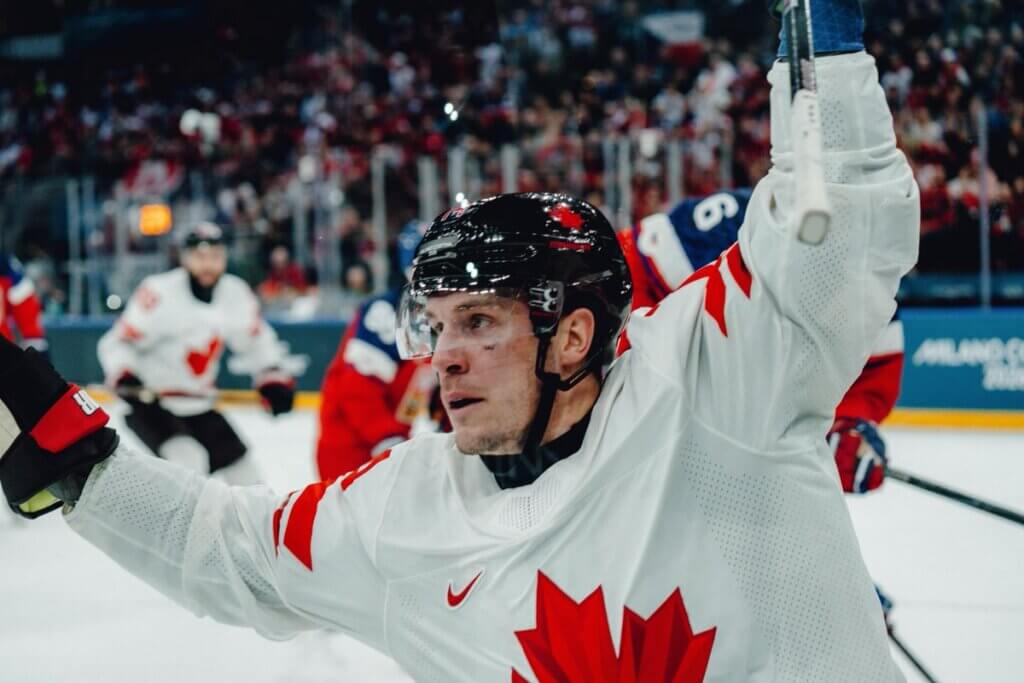
The New York Islanders had to celebrate Bo Horvat’s Olympic goal without showing it. After Horvat scored for Team Canada at the 2026 Winter Olympics, the team posted what it called a “completely realistic and copyright free look” at the play using oversized bobbleheads instead of video.
The joke worked because it pointed to a real limitation. Olympic social media guidelines are built to protect broadcast partners, and accredited individuals are restricted from sharing video of competition areas or field-of-play action. That structure often leaves NHL teams promoting major international moments without the highlights fans expect.
Islanders Forced To Get Creative After Bo Horvat Olympic Goal
A completely realistic and copyright free look at Horvat’s goal! pic.twitter.com/0I1fvOl3Rz
— New York Islanders (@NYIslanders) February 12, 2026
Horvat scoring on the Olympic stage should have been an easy win for the Islanders’ digital team. Franchise accounts typically push big moments within seconds, especially when a captain delivers on an international stage.
Instead, fans got bobbleheads.
The post leaned into humor, recreating the goal with giant figurines rather than risking a copyright takedown. It looked ridiculous by design, but it also made the point clear. Teams want to amplify their players. Olympic rules complicate that process.
For Islanders fans, the workaround was better than silence. Still, it highlighted the gap between modern highlight culture and the Olympics’ tightly controlled media ecosystem.
Horvat’s goal helped Canada beat the Czech Republic 5-0. He will return to action as Canada take on Switzerland on Friday, where top sportsbooks have them as -500 favorites.
Why NHL Teams Cannot Freely Post Olympic Highlights
Olympic social media guidelines exist to protect media rights holders who pay billions for exclusive access. Accredited participants are allowed to capture photos and some audio or video, but not from competition areas or the field of play. Posts that violate the guidelines can be removed.
Participants also cannot post highlights from their own competitions and must rely on official rights holders for game footage. The balance is intentional. The IOC wants athletes and teams to share the experience while preserving the value of broadcast deals.
For NHL clubs, that means one of their players can score a massive goal and the team still cannot distribute the clip unless permission is granted.
Olympic Media Rules Are Changing How Teams Market Their Stars
The Islanders are far from the only organization adapting.
Restrictions have quietly created a new content style during global tournaments:
- graphic recreations
- photo-only posts
- humor-driven animations
- text updates with reaction
The bobblehead stunt fits that playbook. It is compliant while still giving fans something worth sharing.
From a marketing perspective, originality can outperform standard highlight posts. Fans engage with content that feels native to social platforms rather than syndicated from a broadcast feed.
But there is a tradeoff. Teams lose control of how their players’ biggest moments circulate online.
Bo Horvat’s Olympic Stage Creates A Visibility Problem For The Islanders
International tournaments help shape a player’s reputation. Strong Olympic performances can elevate a star’s profile well beyond the NHL audience.
That should benefit the Islanders.
Yet when the team cannot directly show the moment, the connection between player success and franchise branding weakens. Fans often discover highlights through official Olympic channels instead of their favorite NHL accounts.
It is a subtle marketing disadvantage that only surfaces every four years but carries real implications in a digital attention economy.
Islanders Social Media Team Turns Restriction Into Viral Opportunity
Constraints often force better ideas, and the Islanders recognized that quickly.
Rather than fight the rules, the social team leaned into personality. The oversized bobbleheads created a post that felt self aware and internet friendly. Fans understood the joke immediately.
Ironically, the restriction may have produced a more memorable piece of content than a routine highlight repost.
Still, the broader question remains. In an era where fans expect instant video, does limiting team access help the Olympic product, or does it push audiences toward unofficial sources?
Strict Olympic Broadcast Rights Continue To Shape Fan Access
The Islanders’ workaround is a reminder that the Olympics operate under a very different media model than domestic leagues.
In the NHL, highlights function as marketing fuel. At the Olympics, they are premium broadcast assets.
So when Horvat delivered one of the biggest goals of his season, Islanders fans got plastic replicas instead of replay angles.
It looked absurd.
It also made perfect sense.
Until those media rules loosen, expect more creativity from NHL teams whenever their players shine on international ice.
About the Author
